Fullstack Development (Student Thinking)
Introduction
What is Full Stack?
- A full stack feature in software development refers to a feature or functionality that spans both the front end (client side) and the back end (server side) of an application.
- This means that the feature includes everything from the user interface and user experience (what the user sees and interacts with) to the server, database, and logic that make the feature work behind the scenes.
The components or stack of this feature are usually as follows
- Frontend, the part that the user interacts with
- Backend, the sever side of the feature, handling requests, interactions with the database
- Database, Where the apps data is stored and managed
- API, The Application Programming Interface allows the fronted to connect and communicate with backend
Framework
When creating the backend and frontend of your project you should have a clear answer to these two questions
What data will need to be stored for my feature to work, and what endpoints are needed for my feature?
| ID | Author | Title | Body | Timestamp | Tags |
|---|---|---|---|---|---|
What will the wireframe for my feature look like, and how will it be auto-generated?
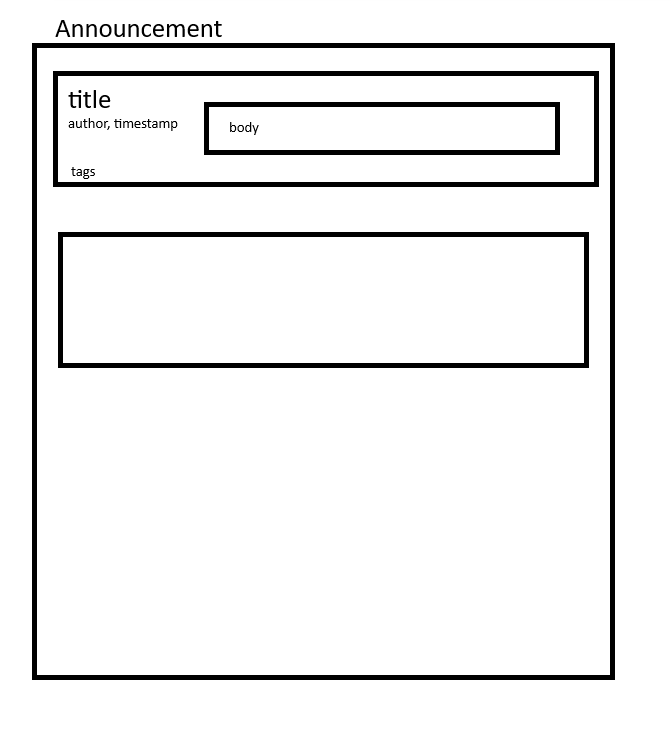
- The questions above are what make your feature workable and unique.
- If you’re able to answer these questions above you will have no problem in seeing the vision of your feature
How to answer the questions with your idea
Start with an idea; I am going to be creating a announcement API!
-
Question #1
- For an announcement feature, I’m going to need an ID (standard in every database), author, title, body, time, and tags data
- For the endpoints think about how this data need’s to be accessed besides the usual CRUD (Create/Read/Update/Delete) methods, maybe a fetch by author or tag
-
Question #2
- Search a a filter to the wireframes, perhaps look at how information is shared in an annoucements tool
- Data presentations will be fetched for each announcement on top of each other with the most recent at the top
Doubt your Doubts
My doubting thoughts on this matter
- The problem with fullstack development is no doubt the barrier entry in terms of knowledge that is needed
- Knowing how to create API’s with specific endpoints, or generating javascript wireframes, it seems like an impossible tasks
- I found that most slackers in groups came from a place of self dismissal “I can’t do this”, “Im never gonna understand this”
My overcoming thoughts
- Use this simple outline to start a GitHub issue
- Start referencing the full-stack materials for Java/Spring with your idea in mind
- Learn the process Sprint: POJO, JPA, API
- Build Postman checks, build endpoint queries for methods: GET, POST, PUT, DELETE
- JavaScript frontend is basically the same as Python/Flask: Desing Forms and format JSON response