
Team Formation & Preliminary Abstract
Week 0: Team Formation & Agile Initialization
Form Your Team
- Form into teams of 2 or 3 students.
- Use the Wayfinding Game and tooling exercise to get acquainted with your teammates and the Capstone workflow.
Brainstorm Problem Ideas
- As a team, brainstorm broadly before narrowing — this is the “Choosing a Problem” step of the Capstone process, not a final commitment.
- Group brainstormed ideas by theme, then vote or discuss as a team to narrow toward the problem directions you’ll investigate in Week 1.
Draft Three Preliminary Abstracts
Write three short preliminary abstracts (about 3–5 sentences each). Bring all three to peer review. After feedback, choose one direction to carry into Week 1.
Each abstract should include:
| Question | Quick definition | What students should identify |
|---|---|---|
| Who? | Who is affected by the problem? | The people, users, or groups experiencing the problem. |
| What? | What is the problem? | The specific situation, difficulty, inefficiency, or unmet need being investigated. |
| When? | When does the problem occur? | The situation, stage, event, or timeframe in which the problem appears. |
| Where? | Where does the problem occur? | The physical, digital, classroom, organizational, or system context. |
| How? | How could the problem be investigated or addressed? | The possible way to collect evidence, test ideas, or develop a solution. |
Project Interest, Team Formation & Identity
Start working together
Use profile setup, Wayfinding Game activities, and group challenges to learn how potential teammates think, communicate, and approach problems.Explore an area of interest
Use the OCS Intelligence Visual to identify an area that interests you and your potential teammates.
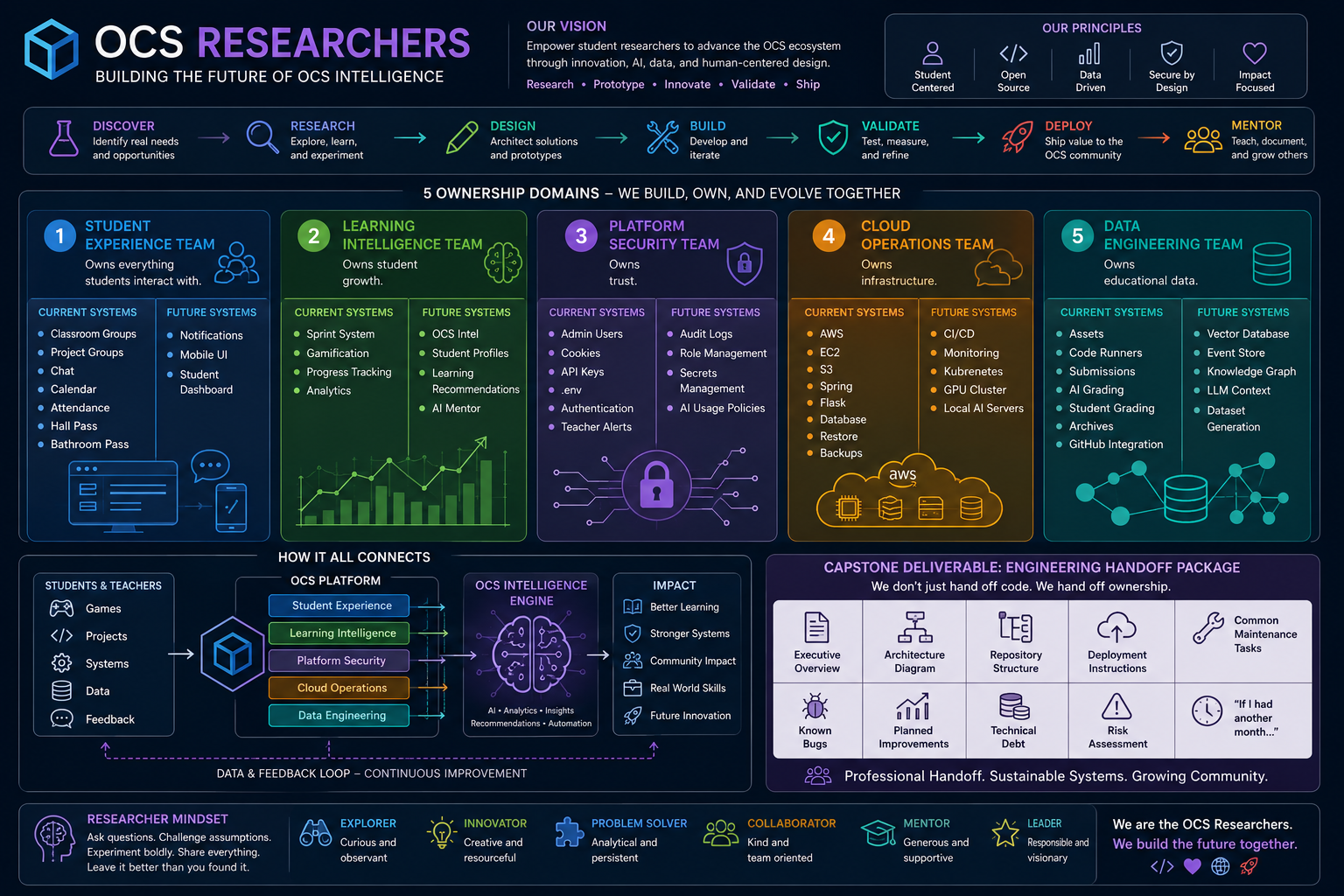
- Student Experience
- Learning Intelligence
- Platform Security
- Cloud Operations
- Data Engineering
Develop team identity
Once you have begun working together, establish a team identity:
- Team Name
- Project Interests
- Agile Manifesto / Team Norms
- Initial Roles
Create three preliminary abstracts
As a team, develop three possible project directions related to your areas of interest. Do not commit to a single problem yet. Use the Who, What, When, Where, and How questions to make each idea specific enough to investigate.
Classroom Sample Option 1 — Cognitive Load in Onboarding
Novice students often experience cognitive overload when starting JavaScript game development in OCS. This study would examine which onboarding steps create the most confusion and which supports reduce overload. The team would collect short reflection data and basic workflow observations. The goal is to identify practical scaffolds that improve early success.
Classroom Sample Option 2 — Classroom Opening and Attendance
In light of new cell phone restriction legislation, teachers face increased demands in the first few minutes of class managing phone collection, attendance, and student readiness. This study would examine whether automated or alternative systems can reduce classroom opening time while remaining reliable and equitable. The goal is to reduce teacher effort and student disruption while getting students ready to learn.
Classroom Sample Option 3 — Team Selection
Students form long-term project teams primarily through existing friendships, which can limit the range of skills, interests, and perspectives within the team. This study would examine whether wayfinding and gamification experiences can help students understand team composition, recognize different perspectives, and make more intentional team choices. The goal is to develop a team-selection process that encourages more diverse and effective project teams.
Peer Review Rubric (Preliminary Abstracts)
Score each abstract on a 1–4 scale (1 = needs major revision, 4 = strong and ready for Week 1).
| Criteria | 1 | 2 | 3 | 4 |
|---|---|---|---|---|
| Problem clarity | Problem is unclear | Problem is partly defined | Problem is clear | Problem is precise and focused |
| Stakeholder impact | Affected group missing | Group named but vague impact | Group and impact are clear | Group, impact, and context are compelling |
| Researchability | No clear way to study | Method idea is weak | Feasible method is present | Method is feasible and measurable |
| Relevance to classroom theme | No clear classroom relevance | Limited classroom connection | Clear classroom connection | Strong classroom relevance and practical value |
Peer-review protocol:
- Present all three abstracts to peers.
- Receive scores/comments for each criterion.
- Revise the top option based on feedback.
- Carry one selected direction into Week 1.
Set Up Your Project Management
- Initialize a professional engineering portfolio.
- Add cards for all three abstract options.
- Create a peer-review decision checkpoint summary.
- Write a summary of the decision process.
- Stand up a digital Kanban board (GitHub Projects) to log tasks, user stories, and acceptance criteria.
Submit Assignment
Need to update a submission later? Open the submissions dashboard.